The airway narrows
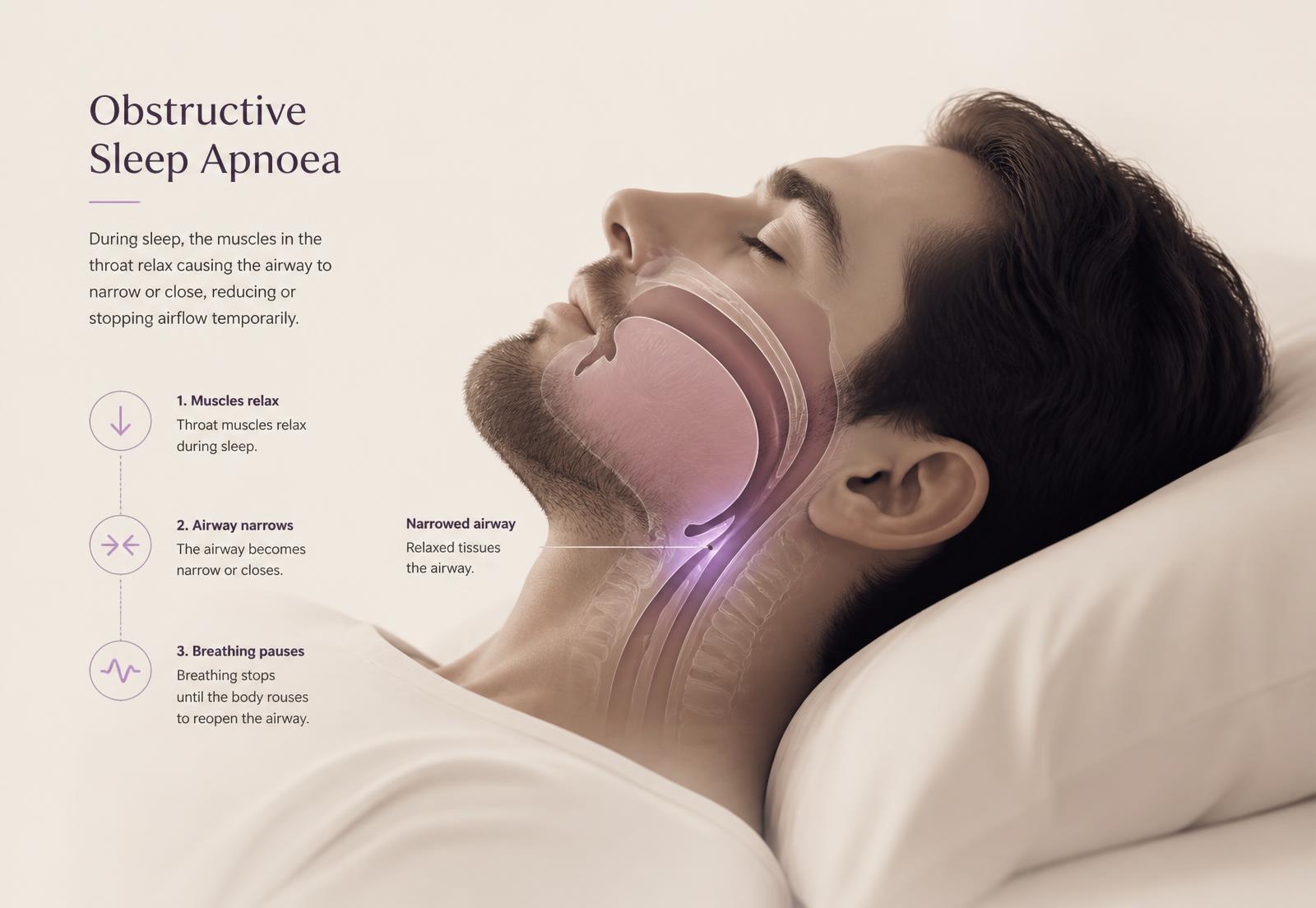
As you fall asleep, the muscles holding your airway open relax. In some people it narrows or closes.
Sleep apnoea
It happens when the upper airway repeatedly narrows or closes while you sleep. Breathing is reduced or briefly stops, and the night becomes work rather than rest.
Many people live with it for years without realising.
What changesAirflow, again and again
In plain words
As you fall asleep, the muscles holding your airway open relax. In some people it narrows or closes.
Breathing is briefly reduced or paused. Your brain wakes you just enough to reopen the airway — usually without you knowing.
It can repeat many times an hour. Time in bed looks normal, but the rest itself is not.
Signs to look for
You do not need all of these. A few, most nights, is reason enough to check.
If this sounds familiar, you can order a home sleep test and start from your own bed.
The whole-body impact
Tap an area to see how untreated sleep apnoea ripples across the body.Explore how untreated sleep apnoea can ripple across the body. Recognising it early and treating it, can mitigate risk over time.
Repeated overnight drops in oxygen and surges in sympathetic activity stress the cardiovascular system. Sleep apnoea is a recognised risk factor for coronary disease and heart failure.
Untreated obstructive sleep apnoea is associated with a higher risk of stroke, driven by intermittent hypoxia, blood-pressure surges and vascular inflammation.
Sleep apnoea is a well-documented cause of difficult-to-control hypertension. Treatment can meaningfully improve blood-pressure readings for many patients.
The relationship runs both ways. Excess weight increases risk of sleep apnoea, and disrupted sleep affects appetite regulation and energy balance.
Persistently fragmented, non-restorative sleep is linked to low mood and depression. Treating underlying sleep apnoea often improves daytime energy and outlook.
Even without full awakenings, brief arousals disrupt deep sleep. The result is unrefreshing sleep, poor concentration and daytime sleepiness.
Severity
Severity is often described as an average number of breathing events per hour. The number helps, but how you feel matters just as much.
Level 1
None
Level 2
Mild
Level 3
Moderate
Level 4
Severe
Your report explains your result in context — no single number tells the whole story.
Myths and facts
“Only people with obesity get sleep apnoea.”
Weight is one risk factor, but sleep apnoea also affects people of a healthy weight. Airway anatomy, age, hormones and other factors matter too.
“Snoring always means sleep apnoea.”
Snoring alone is not diagnostic. Many people snore without apnoea, and some people with apnoea do not snore loudly.
“Eight hours in bed rules out a sleep problem.”
Sleep apnoea disturbs sleep quality even when total time in bed looks normal. You can spend the night in bed and still be undersleeping.
“It only affects older men.”
Risk increases with age and is higher in men, but sleep apnoea occurs across ages and in women, particularly after menopause.
One night is enough to start
A home sleep test can identify obstructive sleep apnoea from your own bed.